
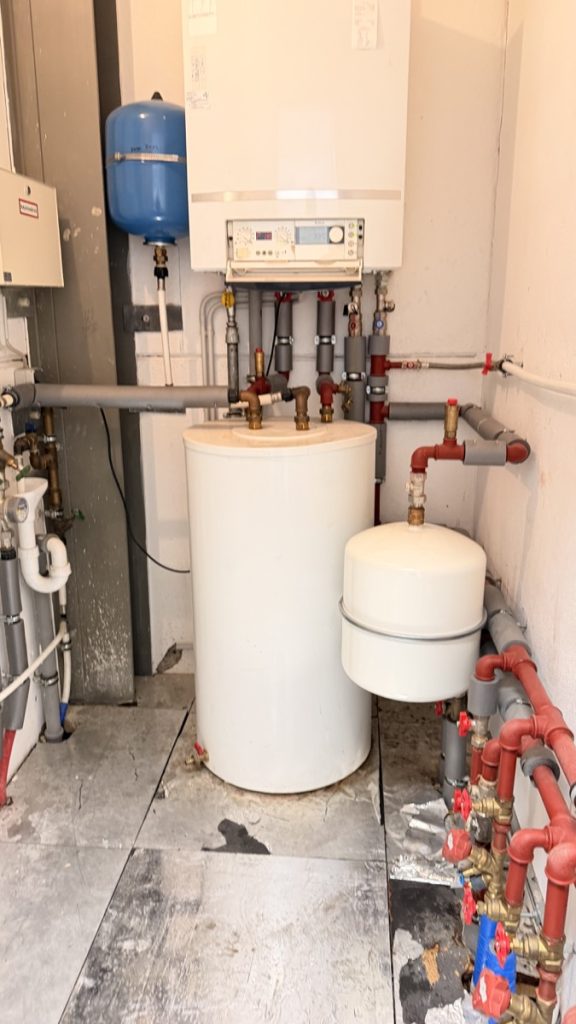
Heating systems make noise. Some sounds are harmless and go away with a simple bleed; others warn of bigger problems brewing. This guide decodes the most common Luxembourg radiator and heating-system noises, what’s causing them, and how urgent the fix is.
Before you start — pinpoint the noise
- Which radiator or pipe is making the noise? (walk around, listen)
- When does it happen — startup, steady-state, cooldown?
- Is it worse after bleeding, after filling, after servicing?
- Is it new, or has it been slowly getting worse?
A 30-second diagnosis here saves a pointless plumber call.
Gurgling / bubbling in radiators
Cause: air trapped in the circuit. Extremely common in Luxembourg homes, especially after refilling, after long summer downtime, or after plumbing work.
Fix (DIY, 10 minutes):
- Turn heating OFF (so circulation stops)
- Start with the radiator furthest from the boiler, or the one making noise
- With a radiator key (on request at any bricolage) open the bleed valve (usually top corner)
- Air hisses out, followed by a dribble of water — close when water flows steadily
- Repeat on each radiator, one at a time
- Check the boiler pressure after — top up to 1.2-1.5 bar if it dropped below 1 bar
Urgency: low. But if radiators gurgle again within weeks, there’s a hidden air source (micro-leak, expansion vessel issue) — call a professional.
Banging / knocking (water hammer)
Cause: hydraulic shock when a valve closes abruptly. Most often:
- Dishwasher or washing machine’s solenoid valve slamming shut at end of fill
- Thermostatic radiator valve closing rapidly
- Toilet cistern refill valve stopping abruptly
Fix:
- Install water hammer arrestors near the noisy appliance (on request part, on request installed)
- Check that pipes are properly clipped to structure — loose pipes amplify noise
- Lower water pressure slightly at the PRV if system pressure is too high
Urgency: medium. Water hammer over years can fatigue joints and cause leaks.
Kettling / boiling-kettle sound inside the boiler
Cause: limescale buildup on the primary heat exchanger causing localized overheating and « steam » bubbles forming and collapsing. Classic Luxembourg hard-water problem.
Symptoms:
- Sound like a kettle boiling, coming from the boiler itself
- Gets worse over time
- Often accompanied by a slight drop in heating performance
- In severe cases, occasional 0Y 276 overheating code on Buderus (see 0Y 276 guide)
Fix: heat exchanger descaling. Cost: on request. Can be prevented by installing a water softener before the boiler.
Urgency: medium-high. Ignored, kettling can lead to primary heat exchanger failure (costly).
Whistling or hissing (boiler or radiator)
Cause (radiator): partially closed valve forcing water through a restriction. Fix: fully open the valve (TRV and return valve).
Cause (boiler): often a failing fan on gas condensing boilers. Get worse over time. Confirms on visual inspection (fan makes a whine at startup). See Buderus 2L guide.
Urgency: medium for fan noise — replace before it fails in winter.
Ticking / clicking at startup or cooldown
Cause: thermal expansion of metal pipes rubbing against clips or masonry. Temperature change → pipes expand/contract → slight movement causes the tick.
Fix: usually harmless. If very loud or annoying, a plumber can identify the offending clip and add insulation/lubrication at the contact point. Cost: on request.
Urgency: low — cosmetic annoyance, not a fault.
Rumbling or vibration in the pump
Cause: circulation pump at end of life, bearings worn. Common on boilers 10+ years old.
Fix: pump replacement on request in Luxembourg.
Urgency: medium. Failing pump can trigger C5 / circulation fault codes (see C5 guide).
Water flowing / trickling sound when heating is off
Cause: constant flow somewhere when the system should be at rest. Possible causes:
- Failed check valve — water circulating by gravity
- Stuck 3-way diverter valve (combi boilers)
- Leak somewhere in the circuit
- Air pocket shifting as temperature changes
Fix: professional diagnosis needed. Cost varies.
Urgency: medium. If accompanied by pressure drop, urgent — probably a leak.
Loud bang on ignition
Cause: delayed ignition — gas accumulates, then ignites in a small « pop ». Common on aging gas burners.
Fix: ignition electrode clean or replace (part of annual service). If ignored, can damage the combustion chamber.
Urgency: medium-high. Book a service appointment.
Preventive — reduce noise before it starts
- Annual service keeps the boiler clean and quiet
- Water softener prevents kettling from scale
- Power-flush every 7-10 years removes sludge that causes pump wear and noise
- Bleed radiators twice a year (autumn + spring) to evacuate air naturally
Frequently asked questions
My radiator bleeds forever and never runs out of air — normal?
No. That’s a sign of a continuous air source — usually a micro-leak (letting water out and air in via negative pressure during cooling) or expansion vessel issue. Call a plumber.
Can noise damage the boiler long-term?
Yes for kettling (scale damages the heat exchanger), pump rumbling (bearing failure cascades), and ignition bangs (combustion chamber damage). Gurgling from air is harmless short-term but indicates a system problem if recurring.
Boiler makes a « whoosh » when it starts — normal?
Completely normal. That’s the fan ramping up and the ignition sequence. Should be brief (under 5 seconds) and smooth.
Need a plumber at your Luxembourg home?
Weber & Fils has English-speaking technicians for 24/7 call-outs across the Grand Duchy: weberetfils.lu/en or call +352 20 60 22 22.
Weber & Fils — 24/7 boiler repair, maintenance and installation.
Request heating service → | +352 20 60 22 22