
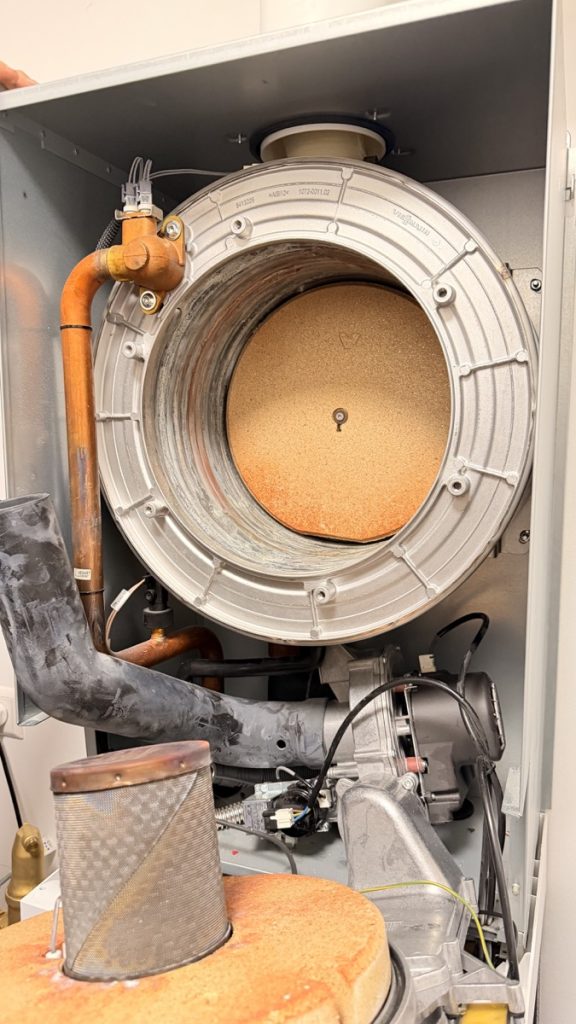
The Viessmann Vitodens 100 is one of the most common gas condensing boilers installed in Luxembourg homes. Simple, reliable, reasonably priced — and with a few quirks that every owner should know. This guide covers what to expect over its lifetime, when to service it, typical faults, and the signals that tell you it’s time to replace.
What is the Vitodens 100?
The Vitodens 100 is Viessmann’s entry-level wall-hung gas condensing boiler. It’s designed for standard residential installations — typically apartments and mid-sized houses. Positioned below the Vitodens 200 (mid-range) and Vitodens 300 (premium) in Viessmann’s line-up.
Key specifications
- Output range: 6 to 35 kW depending on variant
- Efficiency: up to 98% on NCV (condensing)
- Variants common in Luxembourg: Vitodens 100-W (heating-only + external DHW), Vitodens 111-W (combi with built-in DHW storage)
- Control: Vitotronic 100 (simpler than 200 series)
- Burner control: LMU (Lambda Modulation Unit) — same family across Vitodens
- Typical install period in Luxembourg: 2010 to present
Vitodens 100 vs 200 vs 300 — quick comparison
- Vitodens 100 — entry-level, single-stage or basic modulation, cheaper parts and service
- Vitodens 200 — mid-range, MatriX-Plus cylinder burner, better modulation, longer lifetime
- Vitodens 300 — premium, Inox-Radial heat exchanger, smartest controls, highest efficiency
For a standard Luxembourg family home (150 m², 4 people), the Vitodens 100 is adequate. Larger homes or high DHW demand are better served by 200 or 300.
Common issues with the Vitodens 100
Error codes you’re likely to see
- F1 / F2 — ignition or flame loss. Electrode inspection or gas supply check. See burner control guide.
- F5 / F7 — flow or return sensor fault. NTC replacement. See F5 guide and F7 guide.
- D7 — LMU fault. Most expensive fault, typically needs board replacement. See D7 guide.
- E8 / E9 — DHW sensor faults (only on combi variant). See E8 guide and E9 guide.
- B7 — coding card fault. See B7 guide.
Non-code issues
- Pressure drop — most Vitodens 100 installations need pressure topped up every 6-18 months
- DHW temperature drift (combi variant) — usually scale on the plate heat exchanger, needs flushing every 3-5 years
- Noisy operation — often air in the circuit (bleed radiators) or aging pump
- Short cycling — oversized boiler vs demand, or faulty flow sensor
Maintenance profile
- Annual service: legally required in Luxembourg (gas boiler). Typical cost on request.
- Burner cleaning: part of annual service
- Anode inspection (if DHW variant): every 2-3 years, sacrificial anode replacement on request if needed
- Plate heat exchanger descaling (combi): every 3-5 years in hard-water areas, on request
- Full heating circuit flush: every 7-10 years or if sludge detected, on request
Lifetime expectations
A well-maintained Vitodens 100 lasts 15-20 years. Typical failure progression:
- Years 0-5: no issues except occasional pressure top-up
- Years 5-10: minor sensor faults possible, pump bearing noise starting
- Years 10-15: LMU approaching end-of-life, DHW plate needing descaling
- Years 15-20: multiple components needing replacement — start planning for boiler replacement
- Years 20+: parts availability drops, major failure risk high
When to replace vs repair?
Repair is usually economical if:
- Boiler is under 15 years old
- Single fault, not part of a pattern
- Repair cost under on request and fault is a known-fixable component
Replace if:
- Boiler over 18 years old
- Multiple component failures in recent years
- Major fault (primary heat exchanger crack, structural boiler housing corrosion)
- Repair quote exceeds on request 500
See our heating system comparison for modern alternatives when replacing.
Replacement cost in Luxembourg (2026)
- Vitodens 100-W replacement like-for-like: on request 500-on request 000 installed
- Vitodens 111-W combi replacement: on request 500-on request 500 installed
- Upgrade to Vitodens 200-W: on request 500-on request 500 installed
- Switch to heat pump: on request 000-on request 000 installed (before Klimabonus of on request 000-on request 000). See subsidy guide.
Note: as of 2026 Luxembourg no longer subsidizes gas boiler replacements. All heating subsidies go to heat pumps, pellet boilers, and renewables.
Frequently asked questions
How do I find my Vitodens 100 model code and install date?
Open the front cover (top edge). The serial number plate is inside, typically on the right-hand side. The model code starts with « WB1 » for Vitodens 100, followed by variant code. Installation date is sometimes written on the plate or in the Procès-verbal d’entretien.
Can I use any parts or do they have to be Viessmann?
Sensors and minor consumables have third-party equivalents. Critical parts (LMU, MatriX burner, heat exchanger) should be original Viessmann for reliability and warranty. Third-party saving is usually 20-30% but fitment quality varies.
Is the Vitodens 100 available in Luxembourg for new installs?
Yes, still current product. Latest generation has improved efficiency and smart controls. Check with an entreprise agréée for latest pricing.
Need help with your boiler in Luxembourg?
Weber & Fils services all major boiler brands in Luxembourg with English-speaking technicians and stocks the most common parts. For bookings and emergency callouts: weberetfils.lu/en or call +352 20 60 22 22 — 24/7.
All boiler error codes
Viessmann Vitodens 200 & 300: mid-range and premium gas
Viessmann D7 error (burner control unit fault) — what to do
Viessmann B7 error (coding card fault) — explanation and fix
Weber & Fils — 24/7 boiler repair, maintenance and installation.
Request heating service → | +352 20 60 22 22