
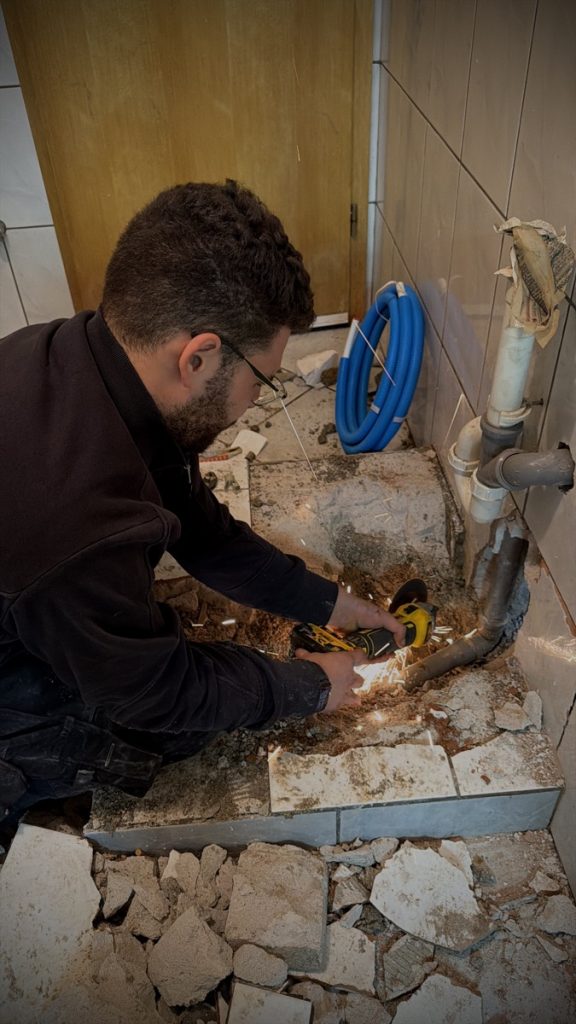
Water is spreading across your kitchen floor, your boiler won’t restart, or you smell gas. In an emergency, the last thing you want is to be fumbling with a French plumbing phrasebook. This guide walks through the most common domestic plumbing emergencies in Luxembourg — what to do in the first 5 minutes, who to call, and what to expect.
First 60 seconds: the emergency shut-offs you should know before they matter
Main water stopcock
Usually located in the basement (cave), utility room, or kitchen near the water meter. It’s a quarter-turn lever or a round valve. Clockwise = closed, anti-clockwise = open. Turn it now just to verify it works before you actually need it.
Main gas shut-off
Usually just outside the property line or at the gas meter. A yellow or red lever. Turn a quarter-turn to close. Only close this if you suspect a gas leak.
Main electrical breaker
The main switch on your fuse board (« tableau électrique »). Flip up the largest breaker to cut all power. Useful if water is near electrical outlets.
Individual shut-offs worth locating
- Under each sink (basin and kitchen)
- Behind the toilet (small lever on the wall)
- On the hot water tank (inlet and outlet valves)
- On the heating circuit (near the boiler)
Scenario 1 — Burst pipe or visible leak
Water is actively coming out of a pipe, joint, or fitting.
- Shut off the nearest valve. If unclear, close the main stopcock.
- Open all taps in the property to drain the pipes and reduce pressure.
- Move valuables / furniture / electronics away from the water.
- Photograph the leak and damage immediately — needed for insurance claims.
- Call your plumber. Emergency callout fee 150-sur devis, but a 2-hour delay can mean 5 sur devis of additional damage.
- Notify your insurance within 48 hours (dégât des eaux clause).
- If you’re renting, notify your landlord as soon as you’ve stopped the water.
Scenario 2 — No hot water
You turn the tap and only cold water comes out.
- Check if the boiler is showing an error code — a letter/number combination like F3, 6A, E6. Note it. Look up the code before calling.
- Check if the boiler pressure is at 1.2-1.8 bar (the round pressure gauge). If lower, the boiler will often refuse to heat water.
- Check if the gas supply to the house works (a gas hob igniting normally confirms it).
- Check the electrical circuit powering the boiler (most boilers need mains power to operate, even gas ones).
- If everything looks normal but the problem persists, call your plumber/heating engineer.
Scenario 3 — Clogged or flooded toilet
Water rising in the bowl and not draining.
- Stop the flow: close the shut-off valve behind the toilet (or close the main stopcock if the valve is stuck).
- Do not flush again — each flush adds more water.
- Try a plunger first (rubber type, not the suction-cup kind).
- If the plunger doesn’t work after 3-4 attempts, do not try acidic drain cleaners — they can damage pipes and make professional unblocking harder.
- Call a plumber with drain-cleaning equipment. Standard call: 120-sur devis. Possible escalations: high-pressure water jetting (hydro-curage) 250-sur devis; camera inspection if recurrent 180-sur devis.
Scenario 4 — Gas smell or suspected leak
A distinctive rotten-egg or sulfury smell near the boiler, hob, or gas meter.
- Do not use electrical switches, doorbells, or phones inside the property. A small spark can ignite gas.
- Open all windows to ventilate.
- Turn off the main gas valve if safely accessible (quarter-turn on a yellow lever outside).
- Evacuate and call 112 from outside or a neighbour’s phone.
- Do not re-enter until the gas service (« Creos » for most of Luxembourg) has confirmed safety.
Gas leaks are rare in modern installations but can be catastrophic. Never dismiss a gas smell.
Scenario 5 — Water heater leaking or flooding
Water pooling under or around the hot water tank.
- Close the cold water inlet valve to the tank (usually a blue-handled valve above the tank).
- Close the gas supply to the tank (if gas-heated).
- Cut electrical power to the tank at the fuse board.
- Open a hot tap in the house to reduce pressure inside the tank.
- Call a plumber. A leaking water heater usually means it’s end-of-life — replacement typically 600-1 sur devis depending on size.
Scenario 6 — Frozen pipes (winter emergency)
No water at a tap during very cold weather, or a strange creaking sound in pipes.
- Close the main stopcock to prevent a burst when the pipe thaws.
- Open the affected tap so water can flow out as it thaws.
- Gently warm the frozen section with a hair dryer or warm towels. Never use a blow torch or boiling water — you can crack the pipe.
- Heat should go outside-in: start from the tap and work back towards the frozen section.
- If the pipe has already cracked, you’ll hear water coming out when it thaws. Be ready at the stopcock.
Prevention: in winter, keep interior temperature above 12°C even in unused rooms, and insulate any pipes running through unheated spaces (garage, basement, attic).
Calling an emergency plumber: what to expect
Response times
In Luxembourg-Ville and the southern industrial belt, 24/7 plumbers typically arrive 30-60 minutes after your call. In rural areas, 1-2 hours is realistic.
Pricing structure
Emergency callouts usually include:
- Call-out fee (60-sur devis depending on time of day)
- Hourly labour (60-sur devis per hour, often minimum 1h)
- Parts at cost + small margin
- Night/weekend/holiday surcharge — typically +30 to +50% on all rates
A typical emergency callout (arrive, diagnose, fix a standard issue) lands in the 150-sur devis range. Complex repairs or part replacements can push it to 500-sur devis.
What to have ready when you call
- Your address (exact — include staircase/apartment number)
- Nature of the problem in 1-2 sentences
- Boiler error code if applicable
- Whether you’ve shut off water/gas already
- Whether you’re the owner or tenant (affects who’s authorised for major interventions)
Documenting for insurance
The moment the emergency is under control, start the documentation:
- Photos — water damage, source of leak, affected furniture
- Invoices — plumber intervention, any emergency supplies bought
- Timeline — when you noticed the problem, when you shut off water, when the plumber arrived
- Declaration — most Luxembourg home insurance policies require written notification of water damage within 5 working days
Keep a copy of your insurance contact details somewhere accessible outside your phone (a kitchen drawer works). In a real emergency, finding the insurance app when phones are wet or batteries are dead is stressful.
Need an English-speaking plumber in Luxembourg?
Weber & Fils has served Luxembourg for over 30 years with technicians who speak English fluently. For bookings, emergency callouts, and quotes, reach the Weber & Fils main site in English:
weberetfils.lu/en or call +352 20 60 22 22 — 24/7 availability, English service guaranteed.
Weber & Fils — 24/7 emergency plumbing, leak repair, drain unblocking.
Request plumbing service → | +352 20 60 22 22